Why WfM will assist the new holiday pay rules that are leaving thousands of UK businesses needing to comply.
Following the government's introduction of the Fair Work Agency (FWA) and its associated rules on 6th April this year. All Businesses across the UK are getting to grips with a demanding new compliance requirement covering UK holiday entitlement and pay.
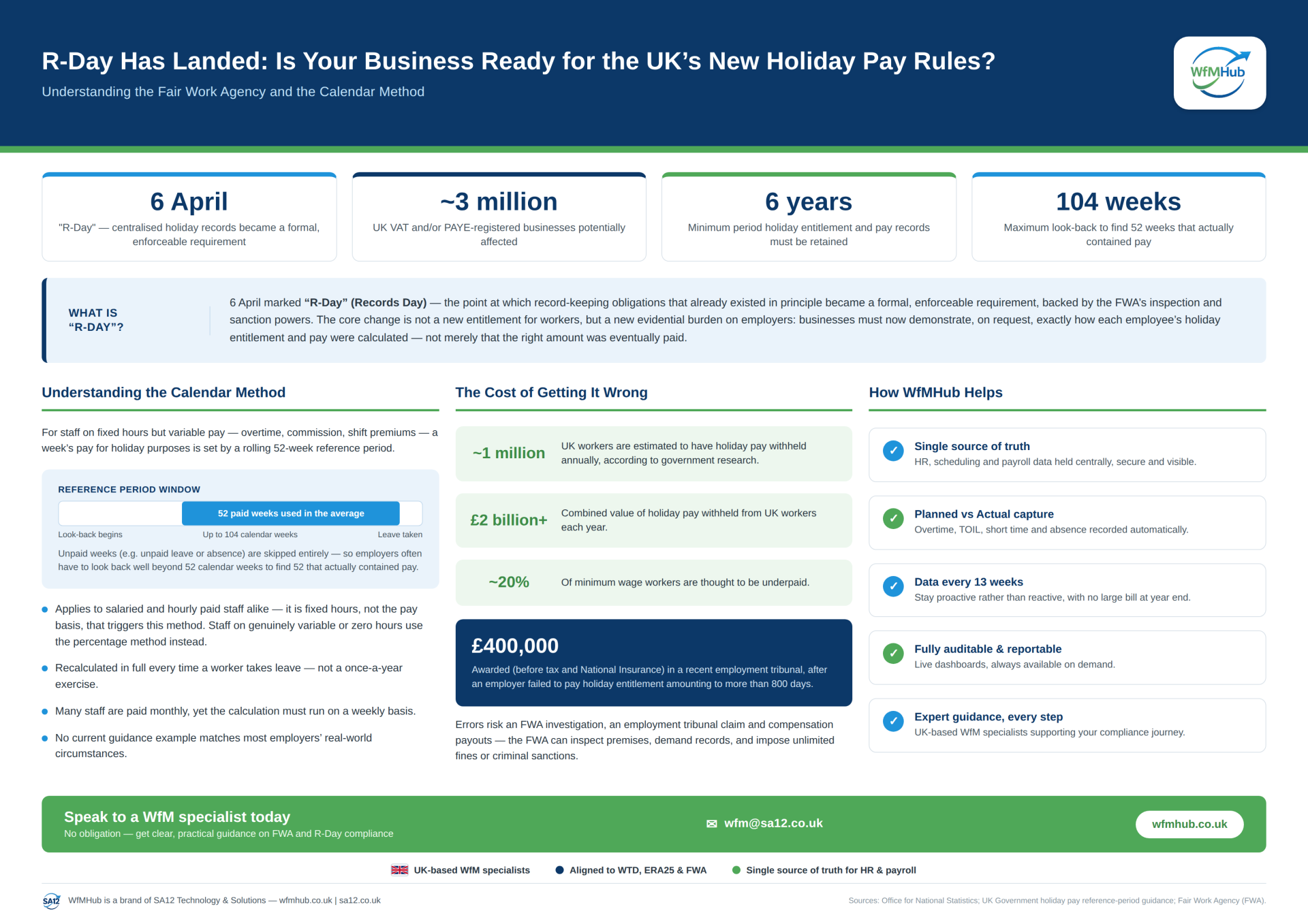
According to the Office for National Statistics, there nearly 3 million VAT and/or PAYE-registered businesses in the UK — meaning a very large number of employers are potentially affected by the new requirements.
Employers must now maintain holiday entitlement and pay records and retain them for six years, in line with National Minimum Wage record-keeping requirements. These records must include annual entitlements, when leave is taken, and what employees are paid for each period of leave, including any payment in lieu of holiday on termination of employment.
Industry specialists are describing the principle as straightforward but in reality, are considerably more complex. Holiday entitlement calculations have traditionally sat with HR teams, while payroll has handled holiday pay itself; the new requirement to hold all of this data centrally and make it readily accessible means the two functions must now work far more closely together than before.
However, WFM has a role and is playing a bigger role in this process, WfM is the only single source of the truth that records all elements of this data. It manages the source data from the HR record, it records all the transactions associated with the records, it always keeps them secure and visible.
It schedules all employees, highlights the different roles and the different rates linked to those roles and it provides the data for what actually happened. It includes Planned vs Actual, extra’s, overtime, short time, TOIL, unpaid instances any additional absences.
All of this factual data is then packaged for Payroll, giving the gross amount to send to payroll for the final part of the journey.
All of this data is auditable, reportable, visible via applicable dashboards and available on demand.
WfMHub’s subscriptions do all of this as standard as well as an experience expert helping, supporting and guiding you every step of the journey ensuring you have accurate data and that you are always on the right side of compliance.
Applies to salaried and hourly paid staff alike — it is fixed hours, not the pay basis, that triggers this method. Staff on genuinely variable or zero hours use the percentage method instead.
Understanding the calendar method
Calculating holiday pay for workers with variable hours and variable pay is relatively well established, using the "percentage method" (broadly, an accrual-based approach applied as leave is earned). Calculations for staff on fixed hours and fixed pay are similarly straightforward, since a week's pay does not vary. The complexity lies with employees on fixed hours but variable pay — for example, those who regularly work overtime, or receive allowances, commission or shift premiums on top of their basic pay. WfMHub deals and manages this for you.
For this group, a "week's pay" for holiday pay purposes must instead be calculated using a reference-period approach, commonly referred to as the "calendar method" or 52-week method. In practice, this means looking back over the 52 most recent weeks in which the worker actually received pay and averaging their pay across those weeks to arrive at a representative week's pay.
Weeks in which no pay was received — for example, due to unpaid leave or absence — are excluded from the calculation and simply skipped over, which means employers may need to look back considerably further than 52 calendar weeks, up to a maximum of 104 weeks, in order to find 52 weeks that actually contained pay.
Because this reference period is a rolling window ending immediately before each period of leave is taken, the calculation cannot be done once a year and then reused. It must be recalculated in full every time a worker takes a period of holiday, since the 52 qualifying weeks — and the average pay they produce — will typically be different each time. This is what specialists mean when they describe the method as needing to be applied "multiple times per worker, per year," rather than as a single annual exercise. It is also why the "52-week" label is considered somewhat misleading: the number of calendar weeks an employer actually has to review, in order to find 52 that qualify, can be twice that.
WfMHub provides this data to you every 13 weeks to enable you to be pro-active rather than re-active and have a large bill to settle at the end.
Analysis by consultants suggests that a substantial number of employers do not fully understand the calendar method or how to apply it correctly, and that underpayments are being identified where variable pay components — such as regular overtime and shift premiums — have not been included in holiday calculations at all. Employers who discover this are often left uncertain how much they may owe, particularly given that back payments may need to cover up to two years. Many are also concerned about the prospect of significant fines or investigation by the FWA, despite having tried in good faith to pay staff correctly.
Specialists working with affected businesses report that well-run companies are seeking help because the calculation method is so difficult for what appears to be the largest affected group of workers, leaving them exposed despite their best efforts — and that, to date, no two employers appear to be approaching the calculation in the same way. As a result, a considerable number of businesses — particularly smaller organisations without dedicated expertise — are understood to be struggling with both the calculation itself and the associated record-keeping.
WfMHub takes this burden off you and becomes your on-demand expert.
A further complication is that many workers are paid monthly, yet the calculation must be performed on a weekly basis. There is currently limited practical guidance on how this should work, and specialists report that no example in existing government guidance closely matches many employers' real-world circumstances. Where many systems are currently understood to be unable of fully handling this scenario under the calendar method.
WfMHub products and services have been designed from the outset to deal with these scenarios and has included all the elements in the subscription to complete this task in line with legislation.
The rules are primarily intended to protect staff on fixed hours who receive variable pay components such as overtime, bonuses, commission and allowances, as well as holiday pay owed in lieu on termination of employment. Specialists note that relatively few businesses have yet grasped the calendar method fully, with many devising ad hoc approaches that do not produce accurate results.
Getting holiday pay calculations wrong risks triggering an FWA investigation, and potentially an employment tribunal claim and compensation payout. Specialists also caution that asking staff to forgo holiday entitlement to cover colleague shortages is not a safe workaround and is likely to create further financial and legal exposure.
The FWA launched in April with enforcement powers to inspect business premises, demand production of records, and impose unlimited fines or criminal sanctions for non-compliance. Government research has highlighted the scale of the underlying issue: an estimated 1m UK workers have holiday pay withheld annually, worth over a combined £2b, and nearly 20% of minimum wage workers are thought to be underpaid.
What R-Day means in practice
From 6 April — the start of the new tax year — all employers have been required to centrally retain accurate records of holiday entitlement, holiday pay calculations and annual leave processed through payroll, for six years. The date has become informally known within the industry as "R-Day", short for Records Day: it marks the point at which record-keeping obligations that already existed in principle became a formal, enforceable requirement, backed by the FWA's inspection and sanction powers. The name reflects the fact that the core change is not a new entitlement for workers, but a new evidential burden on employers — they must now be able to demonstrate, on request, exactly how each employee's holiday entitlement and pay were calculated, not merely that the right amount was eventually paid.
Robust systems must be in place to ensure these records are securely stored and readily accessible to authorised staff, whether held digitally or physically. Industry specialists flagged the potential impact of R-Day earlier this year, warning that many businesses had not anticipated the change and were unprepared for it. WfMHub has been purposely built to deal with this, it's noted that R-Day represents a wake-up call, and that employers need clear protocols for record access and ownership: where records remain fragmented across functions, an FWA inspection can quickly become an administrative emergency. The legislation was also described as a significant shift in requiring teams to work collaboratively around a single source of truth, further good practice would be to have a WfM specialist available to give you the right processes, policies, software, tools, help, support and advice rather than maintaining separate records — with businesses that fail to align facing a risk of compliance failures and potential prosecution for worker exploitation.
The scale of potential liability was illustrated in a recent employment tribunal decision, in which a long-serving former employee was awarded nearly £400k, before tax and National Insurance, after their employer failed to pay holiday entitlement amounting to over 800 days.
Contact WfMHub from SA12 Technology & Solutions to learn more and become compliant.