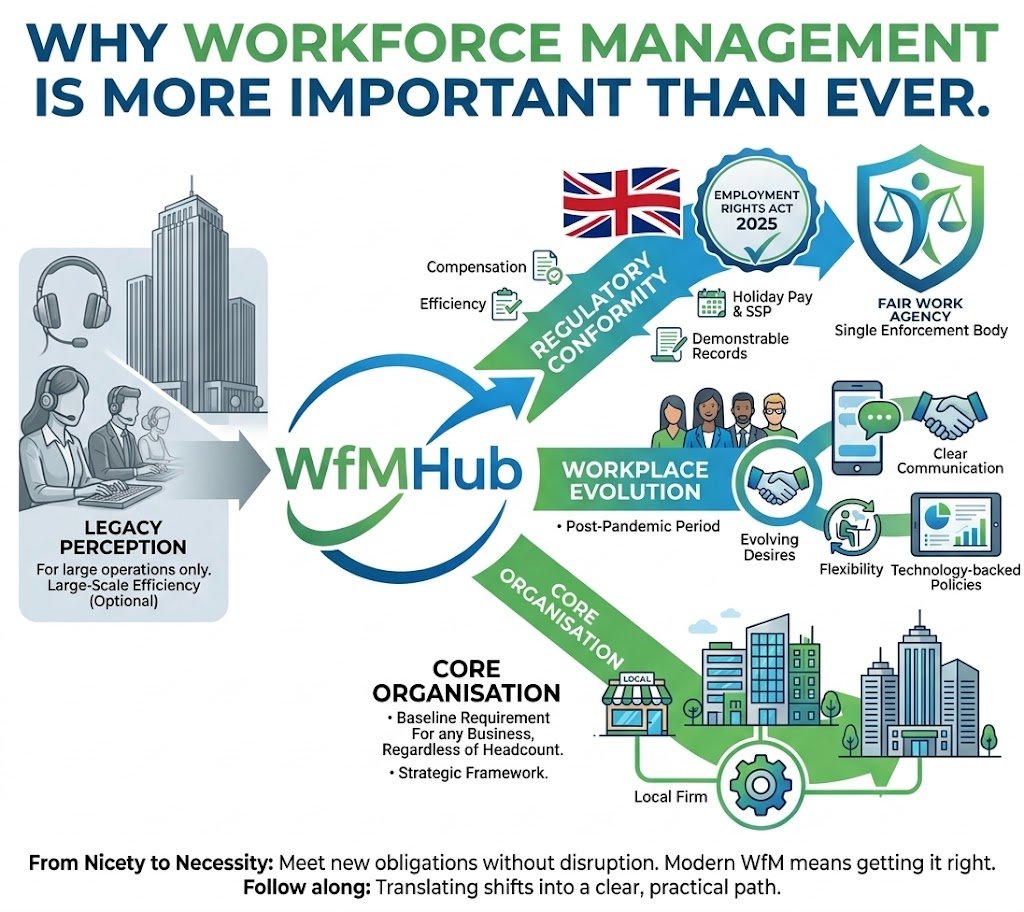
For years, Workforce Management (WfM) was seen as a corporate and call-centre discipline — a way to keep large, complex operations efficient and cost-effective by making sure the right people were in the right place, at the right time, with the right skills.
That perception is now out of date.
A New Regulatory Landscape
The Employment Rights Act 2025 has reshaped the compliance environment for every UK employer. Alongside it, the Fair Work Agency launched on 7 April 2026 as a single enforcement body, consolidating powers previously split across HMRC's National Minimum Wage team, the Employment Agency Standards Inspectorate, and the Gangmasters and Labour Abuse Authority. It has real investigatory and enforcement teeth, and its remit is set to expand — holiday pay enforcement and statutory sick pay are both due to come into scope over the next couple of years.
The practical effect: robust record-keeping, accurate scheduling, and demonstrable compliance are no longer optional extras. They're baseline requirements, and they apply to businesses of every size, not just large corporates with dedicated HR and legal teams.
WfM Has Outgrown Its Original Audience
This is why WfM can no longer be thought of as a "big business" tool. Any organisation with employees — regardless of sector or headcount — now has a direct stake in getting workforce planning, documentation, and reporting right. The businesses that treat WfM as core infrastructure, rather than an operational nicety, will be the ones best placed to meet these new obligations without disruption.
The Workplace Itself Has Changed Too
It isn't only regulation driving this shift. The post-pandemic era reset employee expectations. People want clearer communication, more flexibility, and employers who can back up their policies with the right technology and information — not just good intentions.
Meeting that expectation, while staying compliant and cost-effective, requires smaller businesses in particular, to rethink how they work. That means new processes, smarter use of technology, and a genuine shift in mindset — not just tightening up what's already there.
What's Next
We will unpack these changes in more detail — translating the regulatory shifts and evolving employee expectations into a clear, practical path to compliance and operational change.
Follow along as we get in the heart of what modern WfM really means, and what it takes to get it right.