The Framework at a Glance
The five-step workforce management journey, the core services that deliver each step, and the principles that guide them.
Journey Step - Core Service(s) - Guiding Principle(s) - Key Focus / What It Delivers
1. Strategy
1. Develop Workforce Strategy
Policies and principles
Sets demand-management policy, ensures regulatory alignment, and establishes ownership of establishment (supply vs. demand) data.
2. Planning
2. Agree Workforce Plan
3. Design / Build Base Structure
Base and contingency plans
Builds the base plan for expected demand and resourcing.
Establishes contingency plans for unexpected fluctuations and unplanned events.
3. Delivery
4. Manage & Co-ordinate Real-Time Rotas
5. Operate “Live” Time and Attendance
6. Produce and Report “Live” Actuals
Scheduling and timesheets
Approvals and authorisations
Reporting and KPIs
Manages and co-ordinates rotas in real time.
Tracks live attendance and captures approvals/authorisations as they happen.
Produces live actuals and performance reporting against KPIs.
4. Compliance
7. Ensure Compliance and Maintain Competence
WTR, ERA25, FWA, Skills, Certifications (validations)
Validates against Working Time Regulations, Employment Rights Act, Flexible Working Arrangements, and skills/certification requirements.
5. Capture
8. Transfer Payroll (Gross)
9. Analyse, Optimise and Continually Improve
Analytics, exports and integrations
Continuous improvement and support
Feeds accurate, validated data into payroll.
Closes the loop with analytics, exports/integrations, and ongoing optimisation.
We'll now walk through the first step of the journey in detail, with the rest to follow in future editions.
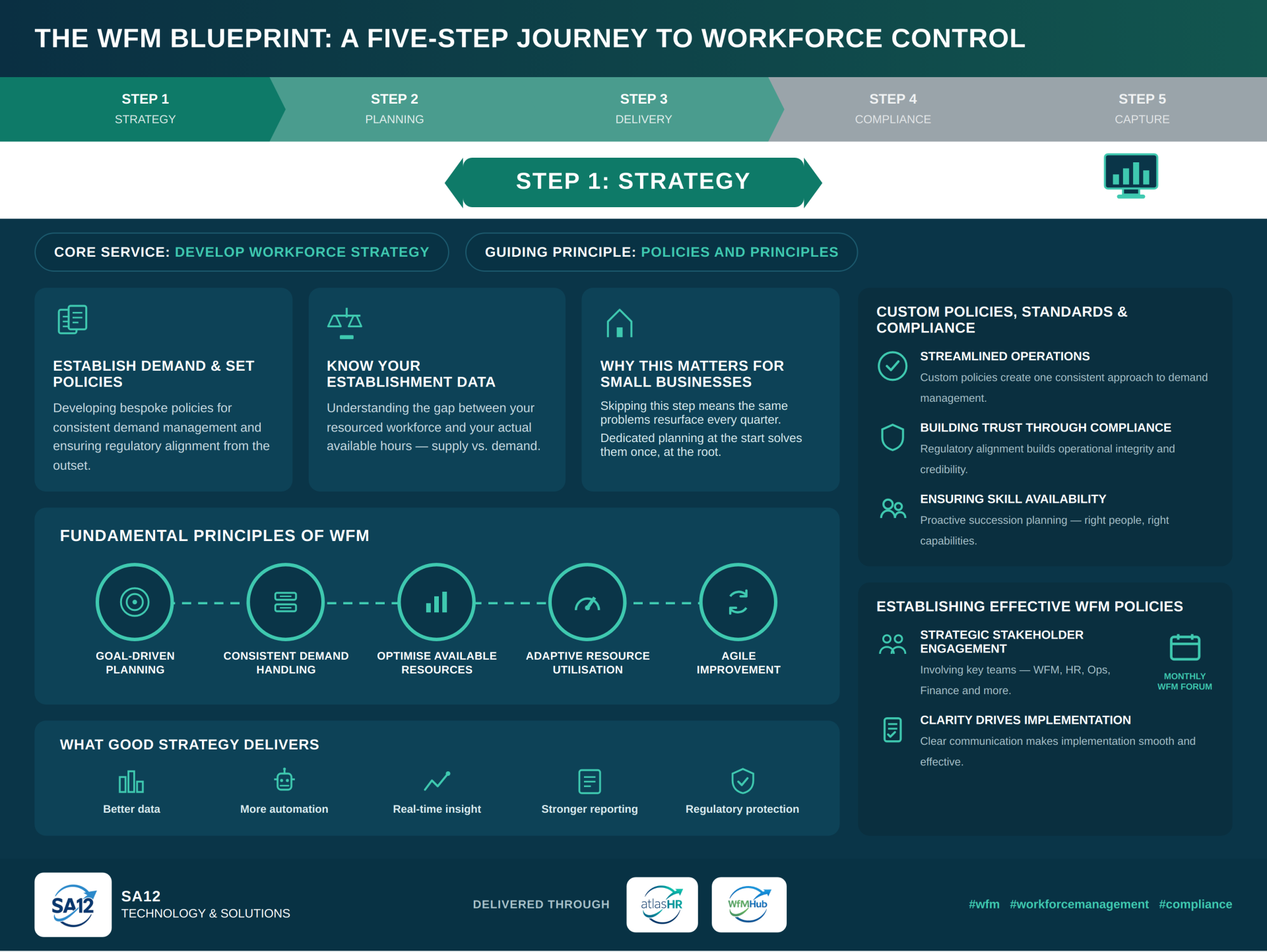
Step 1: Strategy
Core Service: Develop Workforce Strategy
Principle: Policies and principles
Establish Demand & Set Policies and Principles
- Develop bespoke policies and principles to guide demand management, creating a consistent, unified way of working.
- Ensure compliance with regulatory requirements from the outset.
- Know and own your establishment data — the gap between the workforce you're resourced for and the workforce actually available.
For a smaller business, this step matters most because it's usually the one skipped. Without a dedicated WFM function, demand planning often happens informally, which means the same problems resurface every quarter instead of getting solved once.
The Fundamental Principles of Workforce Management
- Goal-driven planning. Start with your business goals and growth aspirations, so every workforce decision ladders up to overall success.
- Consistent demand handling. Standardise demand management through custom-built policies, backed by a solid grasp of your establishment data.
- Optimise available resources. Understand the difference between your total potential workforce and your actual available hours — this is where most resource misallocation hides.
- Adaptive resource utilisation. Continuously adjust planned hours against real operational data to cut waste.
- Agile improvement. Analyse data, spot trends, and feed insights back into your plans for more efficient, cost-effective deployment.
Custom Policies, Standards and Compliance
- Streamlined operations through custom policies. Tailored policies create a consistent approach to demand management — and they work best when shaped by input from management, the people using them day to day, and those implementing them.
- Building trust through compliance. Meeting regulatory requirements isn't just about avoiding legal risk; it builds operational integrity, reputation and credibility.
- Ensuring skill availability. Proactive succession planning protects essential skills, so the right people with the right capabilities are there when you need them.
Establishing Effective Workforce Management Policies
- Strategic stakeholder engagement. Effective policies come from involving the right people — at minimum, WFM, HR, Recruitment, Operations, Training, Finance and Payroll. A monthly WFM forum is a simple way to keep these teams aligned.
- Clarity drives implementation. When policies are communicated clearly and everyone understands their role, implementation runs far more smoothly.
We'll continue the journey with Step 2: Planning.
About SA12 Technology & Solutions
Through atlasHR (our HR platform), WfMHub (our WfM Platform and knowledge, resource centre) and WfM UK (our advisory service), SA12 Technology & Solutions helps businesses put this framework into practice — done properly, it delivers a workforce that's efficient, cost-effective, modern and compliant, with better data, more automation, real-time insight, stronger reporting and greater protection against regulatory risk.
Our difference: we don't just hand over a framework — we do the work with you, guide you through the process, and support you every step of the way.
Want to understand how this could work in your business? get in touch with SA12 Technology & Solutions to start the conversation. wfm@sa12.co.uk
#wfm #workforcemangement #scheduling #digitaltimesheets #wfmhub#cleaningcompanies #homecare #hospitality #pubs #restaurants #fm #abs SA12 Technology & Solutions Ltd