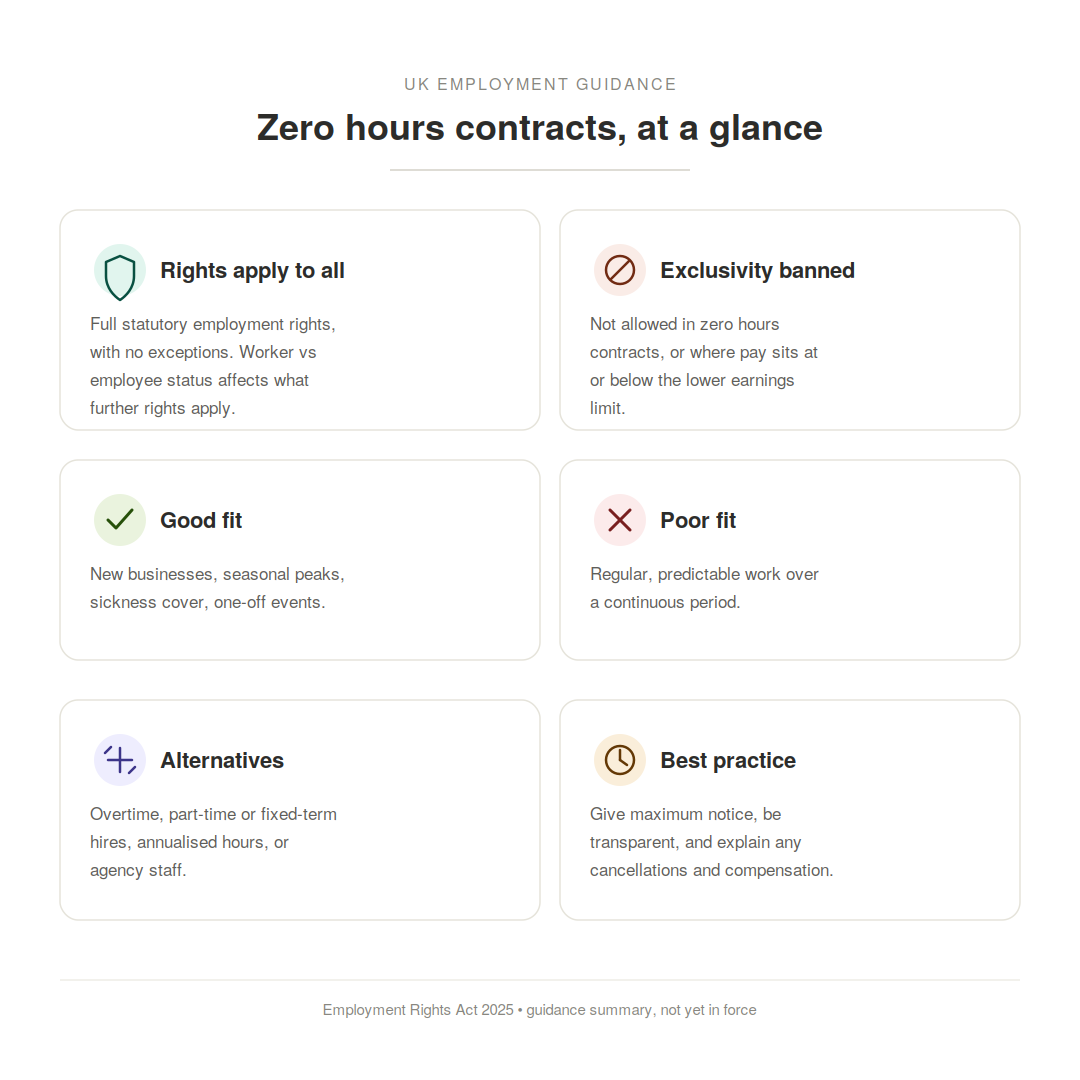
Employment rights. All individuals engaged on zero hours contracts are entitled to statutory employment rights, without exception. Employment status — whether an individual is a "worker" or an "employee" — may affect which further rights apply, and employers should be clear on this distinction.
Appropriate use. Zero hours contracts can be a reasonable option in defined circumstances: for new businesses establishing demand, during seasonal peaks, to cover unexpected staff absence, or for one-off events. They are not intended for work that is regular and predictable over a sustained period; in such cases, a permanent part-time or fixed-term contract is generally more appropriate.
Alternatives. Where a zero hours contract is not suitable, employers may wish to consider offering overtime to existing staff, recruiting on a part-time or fixed-term basis, agreeing annualised hours arrangements, or engaging agency workers.
Exclusivity clauses. Exclusivity clauses are prohibited in zero hours contracts, and in any contract where a worker earns at or below the lower earnings limit. Affected workers are entitled to seek or accept work with other employers, and may disregard any exclusivity clause included in their contract.
Best practice. Employers are encouraged to provide as much notice as possible when offering work, to be transparent about how work will be allocated, and to avoid last-minute cancellations. Where cancellations do occur, employers should explain the reason and clarify what, if any, compensation applies.
Compliance with these principles supports both legal obligations and the maintenance of a fair, transparent relationship with a flexible workforce.
#EmploymentLaw #HumanResources #ZeroHoursContracts #EmploymentRightsAct2025 #WorkforcePlanning